
Biology
KU Biology guides students in the study of life itself, where they learn how about how life works at all levels, ranging from the microscopic to entire ecosystems. Working closely with our sister departments – Molecular Biosciences and Ecology and Evolutionary Biology – Undergraduate Biology teach classes in topics ranging from Virology and Biochemistry to Genetics and Ecology.
Undergrad Bio


Undergraduate Degrees
There are many paths to becoming a Biology Jayhawk. Discover which is right for you, and explore our majors and minor.

Advising
Connect with an Advisor today for information about degree paths, course schedules, and life as a KU Biology student.

Undergrad Bio Cont

Graduate Programs
Our graduate programs can help you advance your career or delve deeper into a specific facet of biology. KU has two a globally-recognized graduate programs that offer PhDs, masters degrees and certificates.

Research
Undergraduate Biology offers diverse research opportunities led by faculty within the departments of Molecular Biosciences & Ecology and Evolutionary Biology. These faculty researchers drive the leading edge of scientific research across a broad range of areas.

Admissions
Everything you need to know about our Biology program and how to apply.

Resources
Check out our sorted lists of important resources for faculty and staff and students.
Biology Jayhawk stories

KU professors implement alternative teaching method in biology classrooms
Dr. Dyan Morgan and Dr. Eileen hotze have developed a new teaching method that features TED talks and discussion prompts alongside their standard curricula, which has led to students being more engaged and demonstrating a deeper understanding of the material.

Electrocuting spores, for science
Biological sciences major Kit Savoy knows that if humans are going to thrive in space, they’ll need microbes. And since wind and animals are hard to come by in outer space, Savoy built a parallel plate capacitor to see whether electric fields can disperse fungal spores instead. It’s mycology plus astrobiology, with a dash of physics thrown in for good measure. Rock Chalk, Kit!

KU receives $5.8 million NIH Phase 3 COBRE funding for Chemical Biology of Infectious Disease center
The Chemical Biology of Infectious Disease center recruits, mentors and supports investigators across the University of Kansas, KU Medical Center, Kansas State, Wichita State and other regional partners as they address urgent challenges in infectious disease and antibiotic resistance using chemical-biology approaches.
KU fungi library is cornerstone of $1.9M grant researching crop drought tolerance
Researchers at the University of Kansas and their collaborators landed a $1.9 million grant to research drought tolerance in wheat and rice. ...

21 University of Kansas students selected for the 2026 Millennium Fellowship class
Selected from a record-breaking 76,000 applicants from more than 6,000 campuses worldwide, 21 University of Kansas students were recently chosen for the 2026 Millennium Fellowship, a leadership development program that partners with the United Nations Academic Impact and is overseen by the Millennium Campus Network.
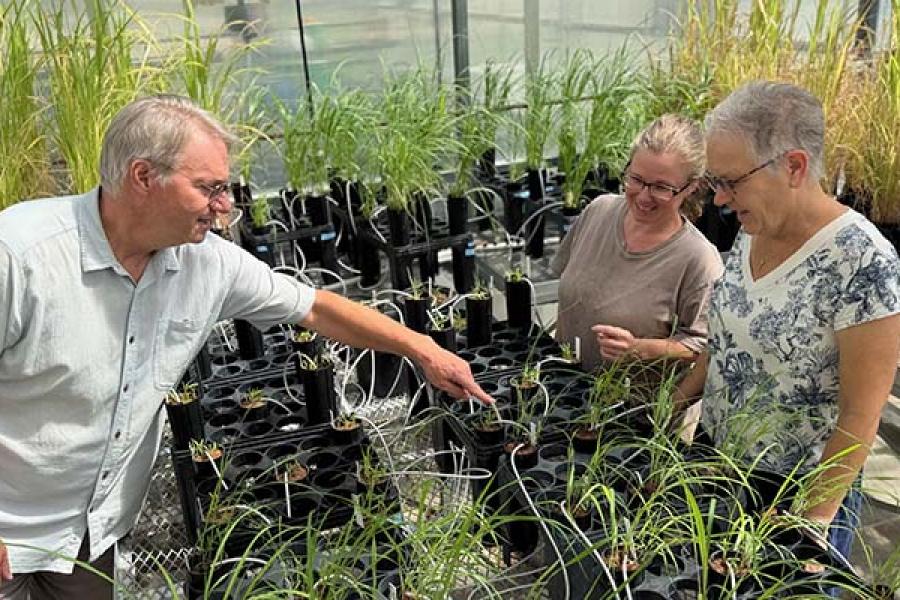
$1.9M grant will support KU research on boosting drought tolerance in crops
A new National Science Foundation grant will bring $1.9 million to KU to test specific types of microscopic soil fungi for their potential to build drought tolerance in wheat and rice.

Biology Student Feedback Form
We would love to hear your thoughts, suggestions or concerns so we can improve KU Biology!
Submit your Feedback